
It looks similar at first glance. Clear sheets. Colored sheets. Decorative patterns. But when heat enters the process, differences become obvious. Glass used for kiln forming must expand and contract at a controlled rate. Without that consistency, layered pieces build internal tension during cooling. That tension may stay hidden at first.
Then the crack appears. Many artists reviewing collections like https://hollanderfusingcenter.com/collections/fusible-glass are specifically looking for sheets manufactured for kiln compatibility rather than decorative glass meant for other uses. Because compatibility is not optional. It is structural.
Why Compatibility Is Non Negotiable
Every sheet designed for fusing carries a COE rating. COE means Coefficient of Expansion. It measures how the glass responds to temperature change.
If two sheets expand at different rates, they pull against each other while cooling.
The surface can look smooth. The bond can seem solid. But internal stress remains.
To reduce risk:
- Use one COE rating per project
- Keep scraps separated and labeled
- Avoid mixing unknown materials
- Confirm product specifications before cutting
Small mismatches create big problems.
Clear Versus Colored Sheets
Clear glass often acts as a structural base. It supports layered designs and allows light to pass through.
Colored sheets change the visual outcome dramatically. Opaque colors block light and create strong contrast. Transparent colors shift depending on what sits underneath them.
Combining clear and colored layers can add depth without excessive stacking.
But layering requires balance.
Too many layers increase thickness. Uneven thickness increases cooling tension.
And tension does not announce itself immediately.
Thickness and Layer Planning
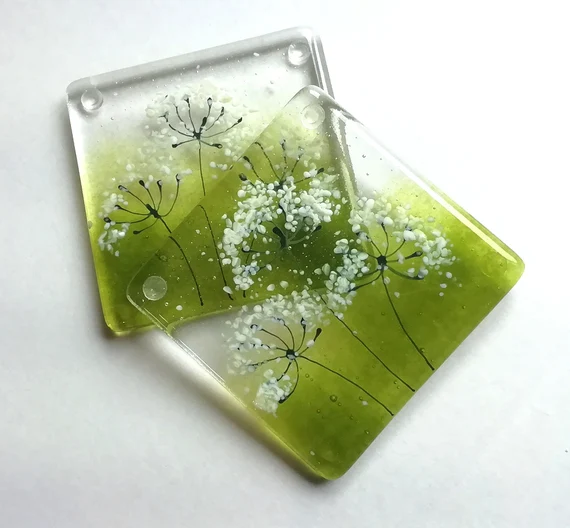
Most fusible sheets come in standard thickness. When stacking, maintaining even builds across the surface improves cooling stability.
For example:
- Two evenly stacked layers cool predictably
- A thick center with thin edges cools unevenly
- Consistent layering reduces stress risk
Planning thickness feels technical, but it becomes intuitive over time.
Observation helps.
Textured Sheets and Surface Results
Textured glass introduces surface detail before firing.
At full fuse temperatures, many textures smooth out. At lower tack fuse temperatures, raised details remain more visible.
Choosing temperature depends on the desired finish:
- Smooth glass for a polished look
- Slight texture for subtle surface interest
- Defined raised detail for decorative effects
Testing small samples clarifies how specific textures behave.
Because each kiln behaves slightly differently.
Project Types That Use Fusible Sheets
Different projects require different material combinations.
Common examples include:
- Jewelry pieces with layered color
- Coasters with simple two layer builds
- Decorative panels using transparent overlays
- Wall art combining opaque and clear sheets
Material choice depends on design intention and structural planning.
Sometimes simpler designs perform better.
Storage and Protection
After purchasing compatible sheets, proper storage prevents accidental mixing and damage.
Store glass:
- Flat on stable shelving
- Separated by paper if stacked
- Clearly labeled by COE rating
- Away from heavy objects
Organization prevents confusion during assembly.
And confusion often leads to mixing incompatible scraps.
Finding Clearly Labeled Fusible Glass
Material selection becomes easier when compatibility ratings are clearly identified. Organized collections such as https://hollanderfusingcenter.com/collections/fusible-glass group kiln compatible sheets in one place, helping artists choose expansion matched glass without uncertainty.
Clear labeling reduces guesswork.
And guesswork has no place in structural work.
Understanding different glass options for kiln work begins with compatibility. From there, thickness balance, color interaction, and firing temperature determine the final result.
When materials are chosen carefully and layered thoughtfully, creative firing becomes far more predictable and stable.